
Arrest Warrants in Newton County
Under Georgia law, several judicial officers can sign an arrest warrant: a superior, city, state, or magistrate judge, plus certain authorized municipal officers. The signature rests on probable cause, shown through the applicant's own knowledge or sworn information. Newton County's own Magistrate Court page lists criminal arrest warrants and commitment hearings among its duties. Once issued, the warrant lets law enforcement take the person named into custody. It does not settle the charge itself. Where the case goes from there depends on the offense and the jurisdiction, so it may land in Newton County Superior Court, the Magistrate Court, or a municipal court. That is why reading the court name on any notice or case paper beats a broad county search alone.
Newton County Arrest Warrant Court
For questions about how a criminal arrest warrant was issued, the Newton County Magistrate Court is the clearest local starting point. The court sits in the Newton County Judicial Center. Reach it at 770-784-2050. Its public jurisdiction statement also covers commitment hearings, which are separate from the later trial of a serious criminal charge.
Use the court named in the case
Magistrate Court can explain its own record and routing. It cannot replace instructions from a Superior Court judge or a city municipal court that issued a different warrant.
The NCSO Warrants page publishes listings, but the court holds the judicial record. When you call, give the clerk a legal name, birth date, and any case or warrant number. That keeps similar Newton County records apart without guessing.
What a Newton County Arrest Warrant Contains
What a warrant shows depends on the underlying court record. Official Georgia materials point to the basics worth looking for: the named person's identity, the alleged offense, the issuing authority, and dates tied to issuance or service. The NCSO monthly PDF is a plain column list, not a field schema. Treat its format as one office's layout, not proof of what every Newton County arrest warrant contains.
| Warrant or case identifier | A number used to distinguish the judicial order or related case. Ask the clerk which number controls. |
|---|---|
| Person identified | Name and other identifiers used to confirm a match. Do not rely on name alone. |
| Alleged offense | The charge or legal basis associated with issuance, not a conviction. |
| Issuing authority | The court or judicial officer responsible for the order and court-side status. |
| Issue and service information | Dates or status terms that may show issuance, service, recall, or another court action. |
Some records leave out public detail. A file may be sealed, tied to an active investigation, or juvenile. When a field is missing from a public list in Newton County, that gap proves nothing either way.
Newton County Arrest Warrant Standard
The official Georgia Courts legal reference summarizes O.C.G.A. § 17-4-40. A qualifying judicial officer may issue an arrest warrant on probable cause, supported by personal knowledge or information given under oath. Probable cause is the threshold for issuance only. It is not the trial standard applied later in a Newton County courtroom.
- Probable cause
- A sufficient factual basis for a judge to authorize the arrest sought in the warrant application.
- Under oath
- Information formally presented with a legal duty of truthfulness.
- Commitment hearing
- An early proceeding connected with custody and the basis for a charge, not the final felony trial.
A private applicant may face a warrant-application hearing, with its own notice and participation rules. Not every warrant begins through a law-enforcement route. Ask the Newton County Magistrate Court about the actual docket rather than assuming one path.
How Newton County Arrest Warrants Are Served
The Newton County Sheriff's Office serves as the county's law-enforcement arm and its public warrant channel. Municipal police can also hold and act on warrants from their own city courts. Service means officers have executed the order by taking the named person into custody or completing the required legal action. Publishing an entry on a list is something different.
- The issuing court creates and maintains the judicial order.
- The warrant is transmitted or entered into the law-enforcement systems used by the responsible agency.
- An officer verifies a possible match against the underlying file before taking action.
- After service, the agency and court update or cancel the appropriate system entry under their procedures.
Covington Police Department's legal-process policy offers one local example. Municipal warrants there are entered in GCIC, a hit is verified against the file, and the record is canceled through the internal workflow after execution when appropriate. That is a city policy, though. Do not assume it governs every Newton County warrant.
Newton County Arrest Warrant List Limits
The NCSO public Warrants page links to a dated PDF and states that warrant information is updated monthly. The visible date matters. It tells you exactly how current the list is, and it also marks the limit: the document is a snapshot rather than a live name-search database for Newton County.
A warrant signed after publication may simply be absent. Sealed, juvenile, and investigative matters can be withheld too, and the landing page offers no complete-list guarantee. For current confirmation, call NCSO at 678-625-1403 and the issuing court. Georgia.gov also warns that an in-person warrant inquiry can lead to immediate custody.
Arrest Warrant vs Summons vs Bench Warrant
These documents can connect, but they do different work. Read the title and the issuing court first. That habit keeps a missed citation in Newton County from being mistaken for an arrest warrant built on a new probable-cause application.
| Record | Core function | Newton County route |
|---|---|---|
| Arrest warrant | Authorizes apprehension based on probable cause. | Confirm with NCSO and the issuing Magistrate, Superior, or city court. |
| Summons or citation | Gives notice of an appearance, charge, or payment obligation. | Use the court and date printed on the original paper. |
| Bench or FTA warrant | Orders apprehension after a missed appearance or unmet court requirement. | Ask the court that set the appearance what recall or appearance process applies. |
A search warrant is different again. It authorizes a search of a described place or evidence, while an arrest warrant in Newton County authorizes taking a person into custody.
Choose the Newton County Clerk
Start with the court printed on the record. For a felony or general-jurisdiction case, contact the Newton County Clerk of Superior Court at 770-784-2035. For a criminal warrant application or commitment-hearing question, call Magistrate Court at 770-784-2050. City-court matters stay with the issuing municipality.
- Write down the exact court, case number, warrant number, and spelling shown on the paper.
- Ask whether the record is active, served, recalled, quashed, satisfied, or restricted from public access.
- Ask which appearance, motion, bond, or attorney process applies to that specific case.
- Record the office name and confirmation date, then verify any later status change with the same court.
For a juvenile case in Newton County, call Newton Juvenile Court at 770-784-2060. Those records stay sealed, so no adult warrant list can answer a juvenile matter.
Newton County Superior Court Role
Newton County Superior Court sits in the Alcovy Judicial Circuit. It holds felony and general criminal jurisdiction. The Superior Clerk keeps the court record. The Newton County Sheriff's Office, NCSO, handles the law-enforcement side. One phone call rarely settles every warrant question, so treat the two offices as partners rather than rivals. The Judicial Center sits at 1132 Usher Street in Covington. You will find the Superior Clerk in Room 338, open weekdays from 8:00 a.m. to 4:45 p.m. Before any in-person visit about an active warrant, ask about custody, bond, counsel, and where to report. Newton County runs no universal walk-in clearance program, so call first rather than assume. The Public Defender, at 770-788-3750, represents qualifying indigent people facing pending criminal charges. Its application fee is not a warrant fee. A private attorney can also explain how a given judge handles surrender, bond, or a motion to recall a bench warrant.
What to Do If There's a Warrant for You
Call official lines first, then show up in person. The Newton County Sheriff's Office answers at 678-625-1403, and its jail line, 678-625-1400, can route questions about jail or bond status. Ask which court issued the warrant, and whether your lawyer should reach that court before you surrender.
- Confirm the record with NCSO and the issuing court using your name, birth date, and any case identifier.
- Ask whether the matter calls for an appearance, bond, attorney filing, or another judge-specific step.
- Discuss custody and bond expectations before traveling to a court, sheriff facility, or precinct.
- After action is taken, verify the status with the court and law-enforcement agency that maintain the record.
Act carefully: an in-person inquiry may lead to immediate custody, and no Newton County office promises a no-arrest warrant counter.
Hang up on any caller who threatens arrest and wants Green Dot cards or bank details. The Alcovy Judicial Circuit is plain about this: court and sheriff staff never make such demands. For the wider picture, see the Newton County warrant overview.
Newton County Arrest Warrant Source
The official Newton County Magistrate Court jurisdiction page names criminal arrest-warrant issuance as a core function of that court.
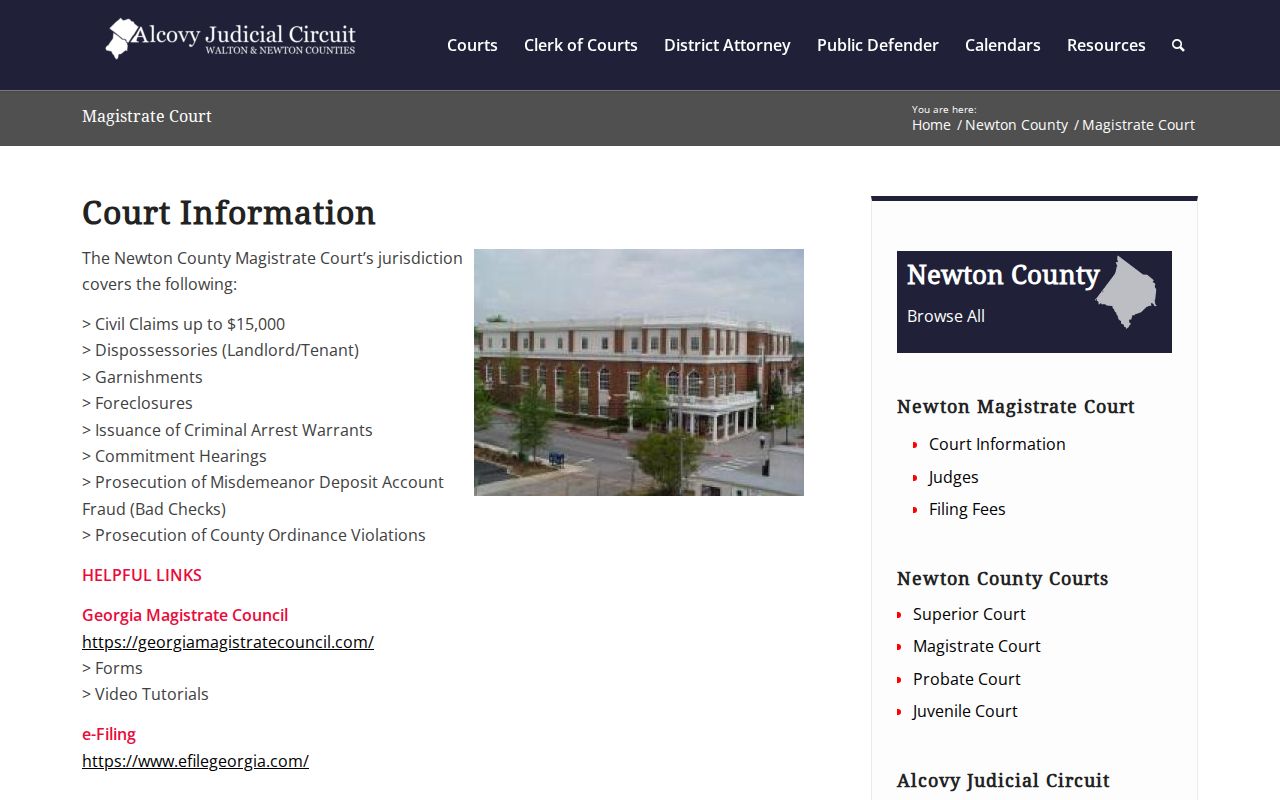
That official page lays out the right court route for a Newton County warrant check. It shares nothing about any private person.